
Review · ROME
Christmas Nativities and Angels Tour in Rome
Rome does Christmas beautifully. This three-hour walking tour links grand squares, old churches, fountains, and seasonal displays, giving you a festive way to see the city beyond its usual ancient monuments. I like the small group of no more than 15 people, which leaves room for questions, and I like the route’s finish at St. Peter’s Square, beside the Christmas tree.
The main drawback is the pace. You visit about 12 places in roughly three hours, with around 15 minutes assigned to each stop. The tour is best for exterior views, stories, photos, and quick church visits rather than long museum-style sightseeing. The Pantheon admission, around €5, is not included.
Key points to know before booking
- A festive route across central Rome: You go from Piazza del Popolo through Piazza Navona, Campo de’ Fiori, the Trevi Fountain, the Spanish Steps, and St. Peter’s Square.
- The Christmas focus is the main reason to book: Your guide explains Roman Christmas customs and points out seasonal nativity scenes, angels, decorations, and photo opportunities.
- A 15-person limit helps: You have a better chance to hear the guide and ask questions than on a large city coach tour.
- The route covers famous sights quickly: Most stops last about 15 minutes, so expect orientation and commentary rather than extended visits.
- The Pantheon costs extra: Admission is not part of the tour price, and the schedule may not allow a long interior visit.
- The walk finishes near the Vatican Christmas tree: You end at St. Peter’s Square, with no return transport provided.
What this Christmas walk is really like
The tour costs $90.70 per person and lasts about three hours. That is not a cheap walking tour, so the value depends on what you want from it. You are paying for a live guide, a seasonal route, a small group, and the convenience of connecting many central sights in one outing.
I would not choose it as the best-value way to see Rome’s major monuments in depth. You can view many of these squares and fountains without paying for a tour. I would consider it worthwhile if you want Christmas context, help finding seasonal details, and a ready-made route through the city without having to plan every turn yourself.
The tour is offered in English and uses a mobile ticket. Pickup and drop-off are not included. You meet at Basilica Parrocchiale di Santa Maria del Popolo in Piazza del Popolo and finish at St. Peter’s Square. Since the route crosses much of central Rome, wear proper walking shoes and plan your onward journey from the Vatican area.
The route is listed as a series of 15-minute stops. That does not mean every stop receives a full quarter hour of uninterrupted explanation. Time is also needed to walk between locations, gather the group, cross streets, and find good viewing positions. Think of the tour as a guided Christmas walk with many short pauses.
The two strongest personal endorsements praise the guides’ attitude and care. One guide was described as friendly and well informed about Christmas traditions. Alessandro was singled out for being well informed and considerate, with the whole arrangement described as easy to manage. Those comments matter because a route like this succeeds or fails on the guide’s timing, storytelling, and ability to keep a small group together.
A few more festive outings around Rome worth booking
- Celebrate Christmas in Rome – Small Group Walking Tour
★ 5.0 · 28 reviews - 2h Xmas Lights Panoramic Vespa Sidecar Tour
★ 5.0 · 15 reviews - Capuchins Crypt: Christmas Baroque Concert
★ 4.8 · 15 reviews
Starting at Piazza del Popolo
Your meeting point is Basilica Parrocchiale di Santa Maria del Popolo, at Piazza del Popolo. This is a sensible beginning because the square gives you plenty to see before the walk even gets moving.
Piazza del Popolo means People’s Square. Its broad neoclassical form was created by Giuseppe Valadier between 1811 and 1822. The scale is grand, and the space has long served as a major northern gateway into Rome.
At the northeast corner is Santa Maria del Popolo. The square also carries a darker memory: public executions took place here for centuries, with the last recorded one in 1826. A good guide can use that contrast to show you how Rome’s beautiful public spaces often carry unsettling stories beneath their polished appearance.
The stop is scheduled for about 15 minutes and costs nothing to enter as a square. If you arrive early, you can get your bearings before the group begins. Do not expect a full church visit unless the guide’s timing and church access allow it, since the published stop emphasizes the piazza.
Piazza Navona and Bernini’s four rivers
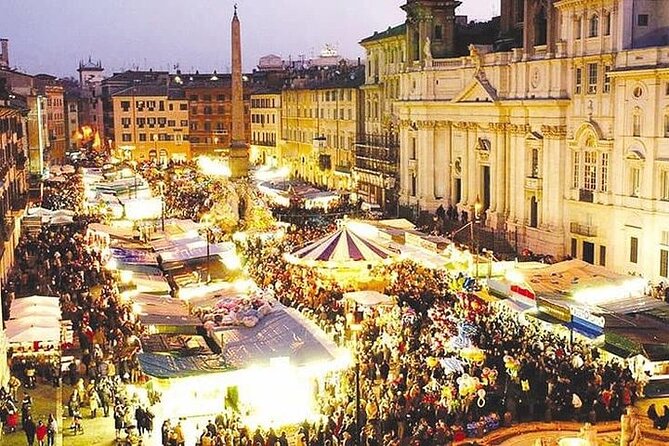
Piazza Navona is one of the tour’s best sections. Its long, curved shape follows the outline of the ancient Stadium of Domitian, a first-century arena built for foot races. The later Baroque decoration gives the square a completely different mood, but the older sporting footprint still explains its unusual form.
Three fountains decorate the piazza. The tour gives special attention to Bernini’s Fountain of the Four Rivers, created in 1651 for Pope Innocent X. The fountain’s center rises from a basin of rough travertine rocks, with four river gods supporting an Egyptian obelisk.
The figures represent major rivers connected with four continents: the Nile for Africa, the Danube for Europe, the Ganges for Asia, and the Río de la Plata for the Americas. Above them is the Pamphili family emblem, a dove with an olive branch.
This is exactly the sort of place where a guide adds value. You can admire the fountain alone, but a short explanation helps you understand why the sculpture is arranged as it is and how papal power was being presented in the seventeenth century.
The stop at Piazza Navona and the separate stop at the fountain are each listed as 15 minutes. In practical terms, treat them as one connected part of the walk. You should have time for photographs and a clear explanation, but not for leisurely café sitting or a detailed study of every fountain.
Campo de’ Fiori and Rome’s harder stories
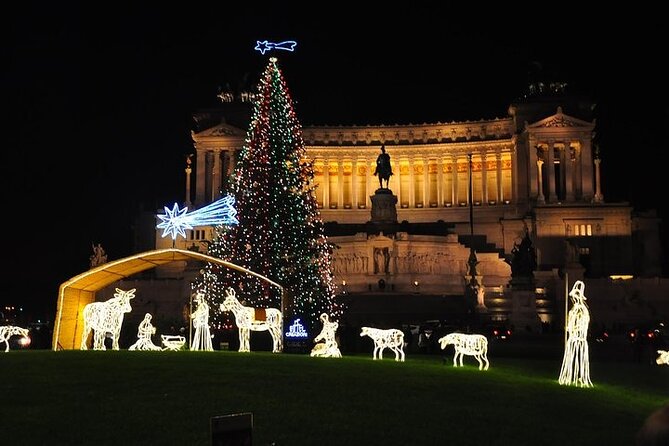
Campo de’ Fiori changes character during the day. In the morning it functions as a market, while in the evening it becomes a nightlife center. The square also has a serious past as a place of executions.
At its center is the statue of Giordano Bruno, installed in 1888 at the site of his execution. The monument gives the square a strong historical focus and helps explain why Rome’s public spaces are rarely just decorative backdrops.
This stop is useful if you want more than holiday lights and pretty photographs. The Christmas season can make Rome feel cheerful and polished, but Campo de’ Fiori reminds you that the city’s past includes conflict, punishment, and public spectacle too.
The tour does not list food, drinks, or market purchases as included. If the market is operating when you pass through, anything you buy is your own expense. The short timing also means you should not count on browsing every stall.
Same town, a different sort of December evening:
- Rome: St. Paul’s Within the Walls New Year’s Concert Ticket
★ 4.4 · 35 reviews - Christmas Eve Mass with Pope Leo XIV at Vatican – Private Tour
★ 5.0 · 10 reviews - Rome: Christmas Nativities and Angels Tour
★ 3.1 · 8 reviews - Capuchin Crypt Christmas Baroque Concert in Rome
★ 4.0 · 7 reviews
The Trevi Fountain and the Pantheon area
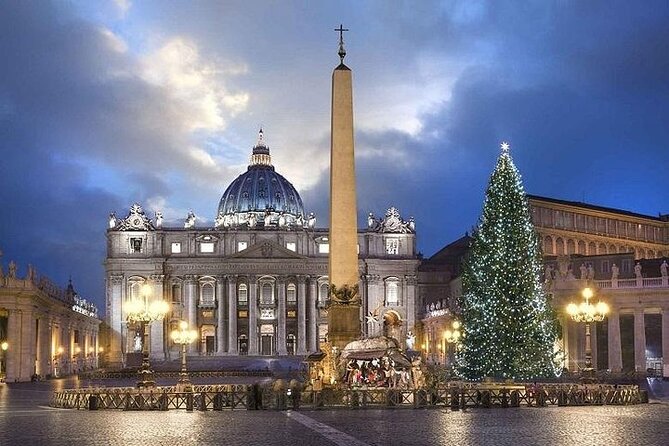
The Trevi Fountain is one of Rome’s most famous sights, and it is included as a free exterior stop. The familiar coin tradition says that throwing a coin over your shoulder into the water means you will return to Rome.
The fountain can be crowded, so a guide helps by giving you a clear meeting point and a set time to look, listen, and take photographs. Still, the tour cannot control how busy the square is. Your best photo may require patience, and the 15-minute schedule will not leave much room to wait for an empty foreground.
The Pantheon is a different kind of highlight. It is one of the best-preserved ancient monuments in Rome and later became a Christian church. The building also serves as the burial place of Italian kings Victor Emmanuel II and Umberto I, Queen Margherita of Savoy, and the Renaissance artist Raphael.
Admission is not included, and the stated fee is around €5 per person. That matters when you calculate the real cost of the day. It also matters because the schedule allows about 15 minutes here. You may see the exterior and receive an introduction, but do not book this tour solely to explore the Pantheon inside at length.
The nearby Piazza della Rotonda is often simply called the square of the Pantheon. It is shaped by the monument itself, with the Fontana del Pantheon in the center. The fountain was designed by Giacomo Della Porta in 1575 and sculpted by Leonardo Sormani. An Egyptian obelisk rises above it.
In the nineteenth century, the piazza was known for bird sellers who brought cages of parrots, nightingales, owls, and other birds. That detail gives the square a more unusual past than its current postcard appearance suggests.
Santa Maria in Via and a smaller church stop
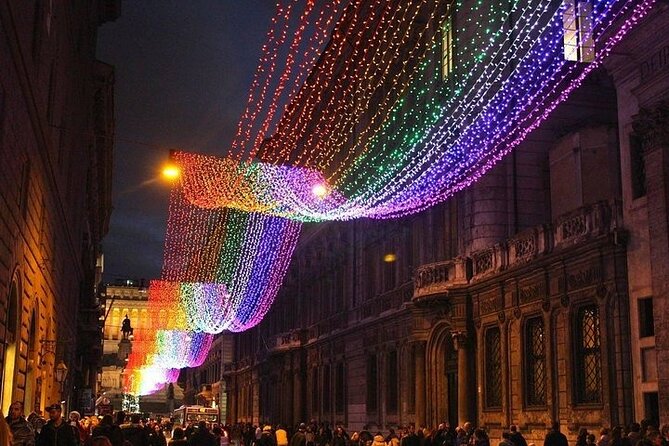
Santa Maria in Via offers a change of scale after the major fountains and grand piazzas. A church or chapel existed here as early as the ninth century, and it was rebuilt after reports of a miracle.
The name means Santa Maria on the Way, referring to the nearby Via Flaminia. The church is also associated with a miraculous freshwater spring. These details give your guide a chance to explain the local religious traditions that shaped Rome’s churches, rather than focusing only on famous architects and popes.
This is one of the places where a small group is useful. A large crowd can make a small church stop feel rushed and noisy. With up to 15 people, you have a better chance of hearing a short explanation and asking about the spring or the church’s history.
As with the other church-related stops, access can depend on the conditions at the site. The tour guarantees the visit to the location, not a long private church tour.
Trinità dei Monti and the Spanish Steps
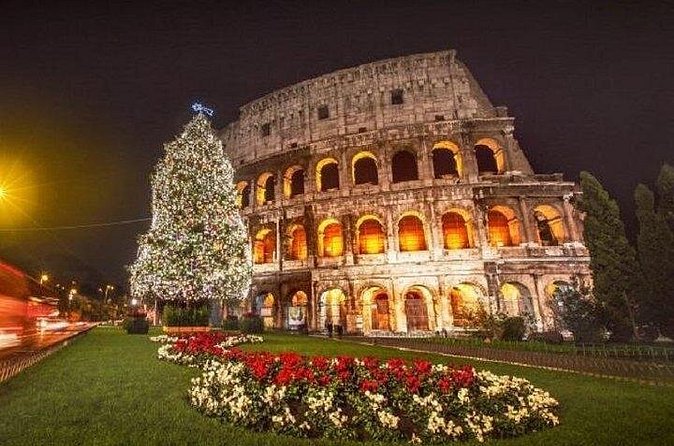
The route continues to Trinità dei Monti, a late Renaissance Roman Catholic church above the Spanish Steps. The church and surrounding area, including Villa Medici, are French state property, an unusual detail in a city filled with competing layers of Italian and papal authority.
From here, the walk reaches Piazza di Spagna at the bottom of the Spanish Steps. The square takes its name from the Palazzo di Spagna, home of the Embassy of Spain to the Holy See.
The area also contains the Column of the Immaculate Conception and the Fontana della Barcaccia. The Barcaccia was created at the beginning of the Baroque period by Pietro Bernini and his son Gian Lorenzo Bernini.
This is another popular photo stop, but it is not a quiet one. The tour’s value here is not exclusive access. It is the guide’s ability to connect the church above, the embassy below, the fountain, and the wider Christmas atmosphere into one short explanation.
The Spanish Steps are also a natural point to judge your energy. By this stage, you have already passed through several major squares and churches. If you dislike steady walking or short stops, the route may feel too compressed.
Ending beneath the Christmas tree at St. Peter’s Square
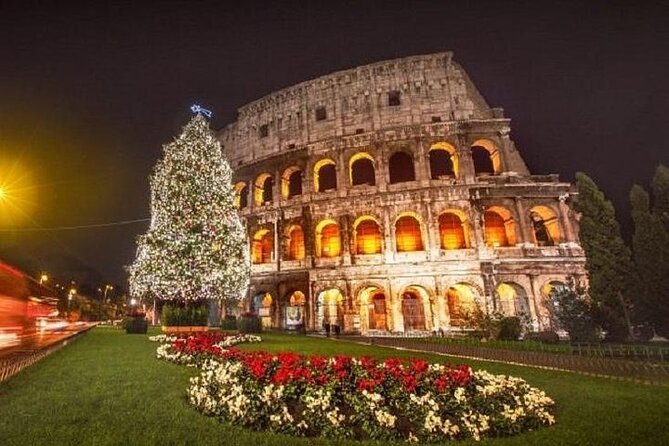
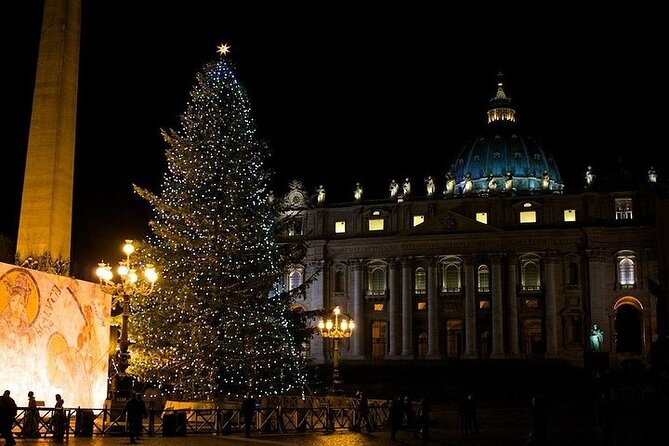
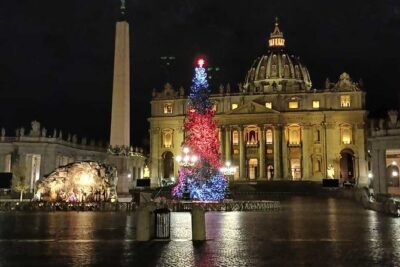
The final stop is St. Peter’s Square in Vatican City. The tour ends here near the Christmas tree, which gives the experience a clear seasonal finish rather than simply ending on an ordinary street.
The square was designed by Gian Lorenzo Bernini almost a century after the central Egyptian obelisk was placed here in 1586. Its great Doric colonnades are four columns deep and were intended to embrace visitors in the maternal arms of the Church.
Two fountains complete the setting. Bernini created one in 1675, while the other was designed by Carlo Maderno in 1613. Even if you have already visited St. Peter’s Basilica, the square offers a strong closing view, especially when Christmas decorations are in place.
The tour ends at the square, not at your hotel and not at a transportation hub specified by the operator. You should arrange your next step in advance. The advantage is that you can continue with Vatican-area sightseeing or simply stay for photographs around the tree. The limitation is that you must handle your own return journey.
Is $90.70 good value?
At $90.70 per person, this experience is priced above a basic self-guided walk. The price makes more sense if you value a live English-speaking guide, a fixed route, a small group, and seasonal commentary.
The route covers a lot. You see Piazza del Popolo, Piazza Navona, the Four Rivers Fountain, Campo de’ Fiori, the Trevi Fountain, the Pantheon area, Santa Maria in Via, Trinità dei Monti, the Spanish Steps, and St. Peter’s Square.
You are not paying entrance fees for most of those places because the main experience takes place in public squares and outside buildings. The Pantheon is the clear extra, at around €5. Food, drinks, tips, and transportation are also separate.
I would book it if you have limited time in Rome and want a Christmas-themed overview without doing the planning yourself. I would skip it if your priority is slow photography, extended church visits, or the lowest possible cost.
Free cancellation is available if you cancel at least 24 hours before the start time. Changes or cancellations made within 24 hours are not accepted for a refund.
Who should book this Rome Christmas tour?
This tour suits you if you want a seasonal introduction to Rome and prefer a guide to connect famous places with local Christmas traditions. It also suits first-time visitors who want to see several central districts in one outing.
It is a good fit for anyone who enjoys asking questions. The group limit of 15 gives you a reasonable chance to speak with the guide, and the positive comments about Alessandro and another friendly guide suggest that the human side of the experience is a major strength.
I would be more cautious if you have mobility concerns, dislike walking, or want to linger inside each monument. The tour recommends comfortable shoes, and the short stop times point to a steady route rather than a relaxed afternoon.
Should you book it?
Book this tour if you want Rome at its most festive, a guide who can explain Christmas customs, and a compact route ending at St. Peter’s Square. The small group and praised guide care are the strongest reasons to choose it.
Skip it if you already know central Rome well or want to explore the Pantheon, churches, and fountains at length. For the right visitor, the tour is a convenient seasonal sweep through Rome’s grandest squares, with enough history to make the Christmas decorations feel connected to the city rather than simply placed around it.
FAQ
How long does the Christmas Nativities and Angels Tour last?
The tour lasts approximately three hours.
Where does the tour begin?
It begins at Basilica Parrocchiale di Santa Maria del Popolo, Piazza del Popolo, 12, Rome.
Where does the tour end?
It ends at St. Peter’s Square near the Christmas tree.
Is the tour offered in English?
Yes. The tour is offered in English and includes a live guide.
How large is the group?
The group is limited to a maximum of 15 people.
Is Pantheon admission included?
No. Pantheon admission is not included and costs around €5 per person.
Are hotel transfers, food, or drinks included?
No. Pickup and drop-off, food, drinks, tips, and gratuities are not included.
New this season around Rome
- Capuchin Crypt Christmas Baroque Concert in Rome★ 4.0 · 7 reviews
- Vatican Private Experience: New Year’s Day Mass with Pope Leo XIV★ 5.0 · 4 reviews
- Christmas in Rome Walking Tour★ 5.0 · 2 reviews
- Christmas Journey in Rome – Private Walking Tour★ 5.0 · 4 reviews
- New Year’s Baroque Concert at Doria Pamphilj Palace★ 5.0 · 2 reviews
- Christmas Eve Mass with Pope Leo XIV at Vatican – Private Tour★ 5.0 · 10 reviews
- Rome: Christmas Lights Walking Tour★ 4.8 · 7 reviews
- Rome: Christmas Nativities and Angels Tour★ 3.1 · 8 reviews
Rome Christmas Tours, compared.
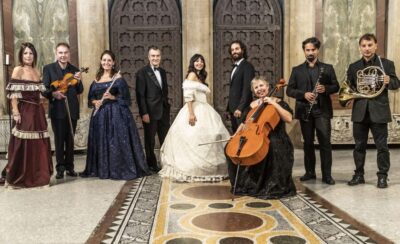
Rome: St. Paul’s Within the Walls New Year’s Concert Ticket
Read our review →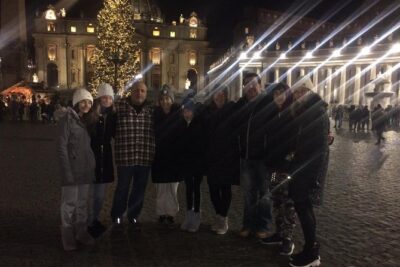
Celebrate Christmas in Rome – Small Group Walking Tour
Read our review →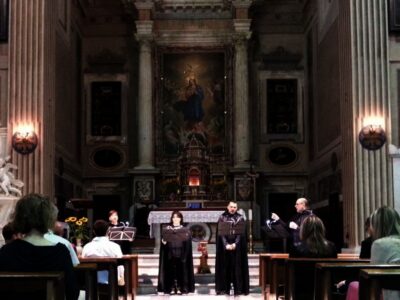
Christmas Eve Mass with Pope Leo XIV at Vatican – Private Tour
Read our review →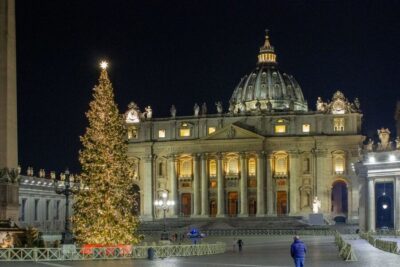
Browse the lists this tour appears in